

Being a pilot is truly exciting and a dream that is shared by many young aspirants. It enables professionals to gain international experience, interact across cultures, and undertake the critical responsibility of flying and managing complex aircraft systems.
However, young aspiring aviators should also know that being a pilot is not just about flying. This job demands precision and the ability to navigate through the sky with confidence. That’s why a strong understanding of radio navigation systems is essential for every pilot.
So, in this blog, we’ll discuss why understanding the radio navigation system is a must for pilots. But before that, let us understand radio navigation in detail.
What is Radio Navigation in Aviation?
Flying an aircraft without radio navigation is like driving a car with your eyes closed. The radio navigation system works as a GPS during flights, which guides the pilots to fly through complex airspaces.
This system uses signals from ground-based stations or satellites to help pilots figure out the position and direction of the aircraft. That’s why it is considered to be the backbone of flying under various conditions.
Also, it ensures safe and efficient flying, which plays a vital role in the modern aviation business.
Why Radio Navigation is a Must for Pilots?
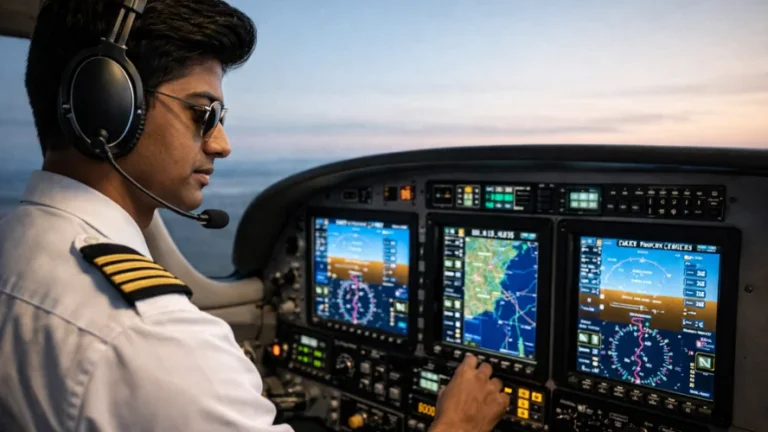
Being a pilot is a responsibility to ensure the safety of every passenger, and that’s where radio navigation comes in. It allows pilots to:
Fly Safe – Radio navigation helps pilots avoid restricted airspace and make a smooth landing in an emergency.
Fly Efficient – Being skilled in radio navigation allows pilots to fly more efficiently. It helps them choose more efficient routes that save fuel and time.
Be Prepared for Anything, Anywhere – Sometimes, pilots have to fly in unfamiliar airspaces or challenging conditions. A thorough understanding of radio navigation systems enables pilots to adapt effectively to diverse situations in any environment.
Stand Out – Mastering the radio navigation system is mandatory worldwide for pilots’ jobs. That’s why being good at this makes you stand out in the industry.
Always choose a top flying school in Patna that offers comprehensive classroom instruction in radio navigation systems. With constant advancements in aviation technology, it is essential to learn updated concepts to keep your knowledge sharp and career-ready.
The radio navigation system has two major advantages in aviation; Safety and Efficiency, which we briefly discussed earlier. Now let’s explore them in detail to truly understand why radio navigation is a must for pilots.
Impact of Navigation on Flight Safety
The most important aspect of being a pilot is providing the highest level of safety to the passengers. For this, pilots rely on radio navigation as it helps them to:
1. Avoid Collision
A modern high-tech radio navigation system is very effective in providing detailed information about the positioning of the aircraft. This information helps pilots know the distance of their plane in relation to other planes to avoid collision. Additionally, in a possible collision situation, the Traffic Collision Avoidance System (TCAS) signals the pilot to take early action to prevent it.
2. Avoid Terrain
Terrain awareness and warning systems (TAWS) help pilots maintain a safe distance from Terrain. The data given by the TAWS system proves very useful when there is less visibility and rugged terrain. This system integrates GPS data with radar to give early alerts to the pilot to avoid any emergency situation.
3. Tackle with Bad Weather
It’s a well-known fact that bad weather can compromise safety during flight. Storm, roughness, lightning, and other weather conditions make the operating environment unsafe. To tackle this situation and navigate the plane to clear a path, the pilots use weather and satellite-based systems. In such conditions, pilots are allowed to change the flight plan for the safety of the passengers.
4. Emergency Situations
Although emergencies are rare in aviation, pilots are always trained to handle them effectively. In situations like loss of communication, engine failure, and other emergencies pilot rely on radio navigation for quick and optimal landing. It allows them to know the accurate position of the nearby airport.
Additionally, the radio navigation system goes beyond ensuring flight safety. This system also plays a crucial role in improving flight efficiency.
Radio Navigation and Flight Efficiency
Safety is indeed a very crucial part of air transport, but along with it, flight efficiency also plays a vital role in aviation.
That’s why the best pilot course in Patna places strong emphasis on the study of radio navigation systems, as they play a crucial role in flight efficiency.
1. Optimized Flight Paths – The modern radio navigation system helps pilots to choose the most accurate flight route. This leads to less fuel consumption and also less emission of carbon.
2. Reduced Flight Time – The radio navigation system allows the pilot to travel in a straight line or choose the shortest route. This saves time in turns and holds, which play a vital role in enhancing passenger satisfaction.
3. Fuel Management – Fuel management is a crucial part of air navigation that impacts flight safety. The system provides data regarding the position, speed, and altitudes of the aircraft, which plays an important role in fuel management.
4. Air Traffic Management – The radio navigation system helps the Air Traffic Controller to maintain the traffic pattern of flying aircraft. This reduces the chances of traffic congestion and delays.
5. Cost Savings – All of these that we discussed till now help airline companies save money in one way or another. Overall cost saving is good for both the airline and passengers as it allows airlines to reduce the travel cost while maintaining high safety standards.
It is fair to say that radio navigation systems form the backbone of modern aviation navigation. This highlights the importance of thoroughly understanding radio navigation as a core subject for every pilot.
If you reside in Patna and wish to gain in-depth knowledge of radio navigation systems through structured classroom learning, get in touch with VayuSa Aviation.
Request a free consultation now to learn about our courses.
Conclusion
In modern aviation, precision and reliability are essential for safe flying, and radio navigation plays a crucial part in this. That’s why radio navigation is a must for pilots. It’s key to flying with confidence and precision.
Mastering this system not only improves flight safety but also enhances operational efficiency.
At VayuSa Aviation, we focus on strengthening students’ understanding of radio navigation systems. We make them familiar with the system in an easy-to-understand manner.
This approach has allowed VayuSa to help hundreds of aspiring aviators achieve their dream of becoming a pilot. Additionally, our institute offers the most affordable cost of pilot training in Patna, with no hidden charges.
At VayuSa, we believe every aspiring pilot deserves the opportunity to achieve their dream because for us, “Sky is Never the Limit”.
So wait no more, request a free consultation now and make your dream a reality.